


The ‘Night Witches’ Became Legends in WW2 Anti-Fascist Struggle
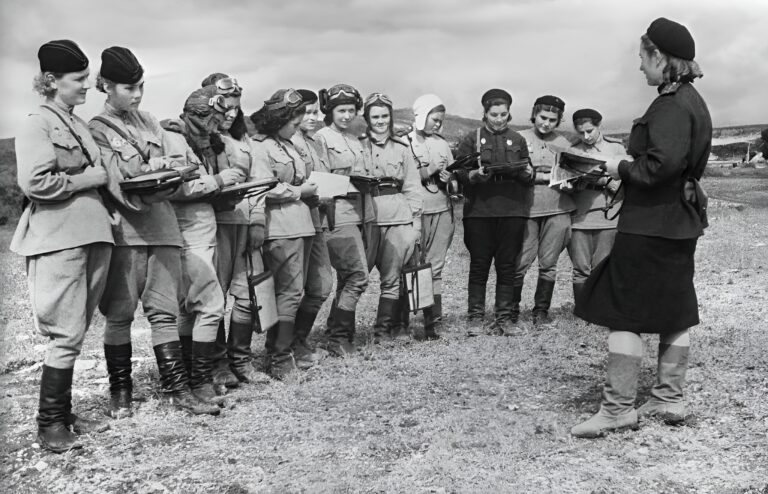
Several members of the regiment are preparing for a mission. Photo: X
May 11, 2026 Hour: 2:59 pm
🔗 Comparte este artículo
These Soviet female pilots utilized stealth tactics to dismantle German military morale.
The history of World War II is often characterized by themes of industrial might and male-dominated front lines. However, one of the most remarkable stories of tactical ingenuity and human endurance comes from the Soviet Union’s 588th Night Bomber Regiment.
RELATED:
Victory Day Persists as Russian Symbol of the Defeat of Nazism
This unit, comprising entirely women, became one of the most decorated entities in the Soviet Air Force. They were given the nickname “Night Witches” (Nachthexen) by German soldiers, a title reflecting the deep-seated fear they instilled in the Nazi ranks.
Operating under cover of darkness with equipment that was considered obsolete even by the standards of the 1940s, these pilots transformed technical limitations into a unique form of psychological and military pressure.
The 588th Regiment was not a symbolic or auxiliary force; it was a fully operational combat unit that participated in some of the most intense theatres of the war. While many nations restricted women to transport or clerical roles, the Soviet Union, driven by the urgency of the Nazi invasion and the advocacy of prominent female aviators, allowed women to fly combat missions.
The story of the Night Witches demonstrates how strategic creativity and sheer discipline can overcome a superior technological adversary. This article explores the origins, tactics, and lasting impact of these women who redefined the possibilities of aerial combat during the 20th century.
The Formation of the 588th Night Bomber Regiment
The formation of the 588th Night Bomber Regiment was largely the result of the persistence of Colonel Marina Raskova. Raskova, also known as the “Soviet Amelia Earhart,” was a renowned navigator who held multiple long-distance flight records.
When Germany invaded the Soviet Union in June 1941, thousands of women volunteered for service but were initially turned away from combat roles. Raskova leveraged her personal rapport with Joseph Stalin to advocate for the establishment of all-female aviation units.
In October 1941, her efforts met with success, leading to the authorization of three female regiments. The most renowned of these was the 588th, which specialized in night harassment bombing.
The regiment’s composition was unique in military history. Women occupied every role, from pilots and navigators to mechanics, loaders, and administrative staff. The majority of these volunteers were young, ranging in age from 17 to 26. They were recruited from universities and flight clubs across the Soviet Union, bringing with them a high level of education and a strong ideological commitment to defending their territory. Despite their enthusiasm, they encountered significant skepticism from their male counterparts, who often viewed the all-female units as a temporary experiment rather than a serious military force.
The training for the 588th was exceptionally rigorous, consolidating several years of military aviation instruction into a condensed programme. The recruits were based at a small airfield in Engels, where they underwent training in navigation, night flying, and aircraft maintenance.
As the military had not anticipated a female combat force, the women were issued oversized men’s uniforms and boots, which they had to stuff with torn bedding to make them fit.
This absence of specialized equipment did not hinder their efforts; instead, it nurtured a spirit of self-reliance and group cohesion that would become a hallmark of the regiment throughout its deployment on the Eastern Front.
Technical Challenges and the Polikarpov Po-2 Aircraft
The operational reality of the 588th Regiment was characterized by extreme simplicity and significant risk. The pilots flew the Polikarpov Po-2, a 1920s-era biplane originally designed for flight training and agricultural crop-dusting.
The aircraft was constructed almost entirely from wood and canvas, making it highly flammable and susceptible to tearing. Due to the lightweight nature of the aircraft, they were only able to carry two bombs at a time, with one bomb stored under each wing. This resulted in the crews conducting multiple missions per night, returning to base to reload before redeploying to the front lines.
Operating the Po-2 required significant physical and mental stamina. The cockpits were open to the elements, exposing the pilots and navigators to the freezing Russian winter. Temperatures were frequently so low that contact with the metal components of the aircraft could result in instantaneous frostbite.
In an effort to minimize weight and maximize the bomb load, the women flew without parachutes or radios. They navigated using only maps, compasses, and stopwatches. They also flew in complete darkness to avoid detection by German anti-aircraft searchlights.
Strategic Tactics: The Art of Silent Harassment
The “Night Witches” developed specific tactics to compensate for the slow speed and fragility of their aircraft. The primary objective of these attacks was to create an atmosphere of constant anxiety among German troops and to prevent them from resting. This strategy was known as “nuisance bombing”.
By conducting intermittent attacks throughout the night, the 588th effectively disrupted the enemy’s logistics network and diminished the morale of the ground forces. The psychological impact of these raids often outweighed the physical destruction they caused, as German soldiers felt they were never safe from the sky.
The regiment’s most renowned tactic was a perilous maneuver known as “silent gliding”. As the pilots approached their target, they would throttle their engines back to idle or even shut them off entirely. This enabled the biplanes to glide silently over the German positions.
The only audible warning for the soldiers below was the faint sound of the wind whistling against the wire braces of the wings. This unidentified noise prompted a comparison by the Germans to broomsticks, leading to the adoption of the “Night Witches” nickname.
The Geography of Combat and the Battle of the Blue Line
The 588th Regiment advanced along the front lines across a substantial geographical area, moving from the southern plains of the Soviet Union towards the heart of Germany. Their combat path began in the North Caucasus and moved through the Kuban region, where they played a pivotal role in halting the German advance towards Soviet oil fields.
As the war’s tide turned, the regiment played a pivotal role in the liberation of the Crimean Peninsula, advancing through Belarus and Poland. By 1945, the women were flying missions over the outskirts of Berlin, maintaining their relentless pace until the final days of the conflict.
The most notable engagement for the regiment took place in 1943 during the battle for the “Blue Line,” a heavily fortified German defensive position on the Taman Peninsula. The German forces had installed dense concentrations of anti-aircraft guns and searchlights to protect this strategic corridor.
In order to break the line, the pilots of the 588th flew at extremely low altitudes, skillfully avoiding fire and searchlight beams to target ammunition depots and fuel supplies. During this campaign, some pilots, including Nadezhda Popova, achieved up to 18 sorties in a single night. The success of the Blue Line operation demonstrated the regiment’s capability to penetrate even the most advanced defensive networks.
Legacy in the Fight Against Fascism and Inequality
The military record of the 588th Night Bomber Regiment is statistically significant. During the war, the unit completed over 30,000 missions and dropped approximately 23,000 tons of bombs.
A total of 23 women from the regiment were awarded the title of Hero of the Soviet Union, the nation’s highest military honor. Their contributions were vital to the eventual defeat of the Nazi forces on the Eastern Front, demonstrating that gender was not a factor in the ability to execute complex and dangerous military operations.
In addition to their military accomplishments, the Night Witches have left an enduring legacy concerning the role of women in society. By successfully managing every aspect of their regiment, they challenged the prevailing patriarchal views of the mid-20th century, which saw women as unfit for direct combat.
Despite being overlooked during the post-war victory celebrations, the history of these women has been preserved as a testament to human resilience. Today, the 588th Regiment continues to serve as a beacon of hope, a symbol of resilience, and a pioneering example of women’s empowerment in the face of extreme adversity.
Sources: BBC – Warfare History – Meer Cultura – Aircrew Remembered – Historias Segunda Guerra Mundial – The Archive – Sputnik – TRT World – TASS
Author: Silvana Solano
Source: teleSUR